Background
On January 20, 2026, the Department of Children, Disability and Equality’s (DCDE) Parenting Support Policy Unit hosted a Year One Progress Report event for the Local Area Child Poverty Action Plan Pilot Scheme. The event allowed the four pilot areas – Dun Laoghaire-Rathdown/Wicklow, Kildare, Monaghan and Tipperary – to present on progress so far. The audience comprised 46 stakeholders from across Government Departments, statutory agencies, community and voluntary organisations, and academia.
The Scheme was designed by DCDE and the Department of Rural and Community Development and the Gaeltacht, in consultation with the Department of the Taoiseach’s Child Poverty and Wellbeing Programme Office. Under this Scheme, DCDE provided €756,000 through the Dormant Accounts–funded What Works initiative to establish four two-year Local Area Child Poverty Action Plan pilots. Children and Young People’s Service Committees (CYPSC) and their corresponding Local Community Development Committee (LCDC) were invited to submit a joint application to design and implement a pilot plan that responds to their local realities and contexts across 2025/26.
The pilots hope to test innovative ways to improve the ways that services work together for children, young people, and families facing disadvantage. They form part of Ireland’s European Child Guarantee National Action Plan and are included under Action 55.2 of Young Ireland, the national policy framework for children and young people.
Pilot Presentations
The event opened with remarks from Lara Hynes, Assistant Secretary of the Child Policy and Tusla Governance Division. She acknowledged the work the pilots were doing to embed stronger interagency partnerships in their areas; noting the intense consultation and research phases that the pilots spent much of year one completing, she said that “policy works best when it’s grounded in real life, when we listen to communities, the evidence, and the lived experience of those it aims to serve.”
Presentations from each pilot area on progress across year one followed, with the Dun Laoghaire-Rathdown/Wicklow pilot presenting on their project first. The presenters were Fionnuala Curry, the Wicklow CYPSC Coordinator, and Adele O’Neill, Research and Community Networking Specialist from a key project partner, Bray and North Wicklow Area Partnership. For their project, F:ACES (Family: Adult and Child Enhanced Services), the pilot consortium seeks to use a relational approach to tackling child poverty, focusing on early childhood (pregnancy-age 4). The audience heard about the intensive stakeholder engagement that took place across the first year, and the innovative Human Learning Systems methodology employed to facilitate this engagement. The presenters talked through their emphasis on relationship-building, learning and adaptation, and experimentation to tackle complex and wicked problems. The presenters also demonstrated the pilot’s systems mapping approach, which included sample images from their new interactive digital systems map.
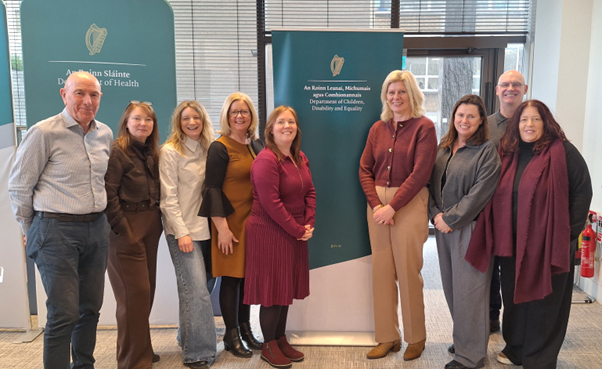
L-R: Peter Brennan, CEO, Bray and North Wicklow Area Partnership; Adele O’Neill, Research and Community Networking Specialist, Bray & North Wicklow Area Partnership; Helena O’Brien, Dun Laoghaire-Rathdown CYPSC Coordinator; Fionnuala Curry, Wicklow CYPSC Coordinator; Maryrose O’Brien, SPECS Early Intervention & Family Support Manager, Bray & North Wicklow Area Partnership; Cathaoirleach Melanie Corrigan, Wicklow LCDC; Imelda Halton, HSE Health and Wellbeing; and Sandra King, Southside Partnership.
A presentation from two representatives from the Kildare LACPAP pilot followed: Emma Berney, Kildare CYPSC Coordinator, and Maria Healy, Local Development Officer from Kildare Sláintecare Healthy Communities. The presentation began with a summary of the pilot’s objectives: to improve access to services for disadvantaged families with neurodivergent children in Kildare by piloting community-based occupational therapy and new flexible referral criteria across three Family Resource Centres (FRCs). The audience heard that a Senior Occupational Therapist was appointed early in 2025, and that by October, 40 children had received 1-2-1 Occupational Therapy. A key deliverable from the research phase of the project, the Kildare Poverty Profile, was launched in November 2025, and a new information resource for parents and professionals was drafted for publication in year two. This took place alongside planning for group-based supports and school‑based professional development in 2026. The experience, knowledge and commitment of project partners (such as the Occupation Therapy lead, staff from the four partnering FRCs and the community neurodivergence support initiative Space2Be) were noted as significant enablers of success across year one.
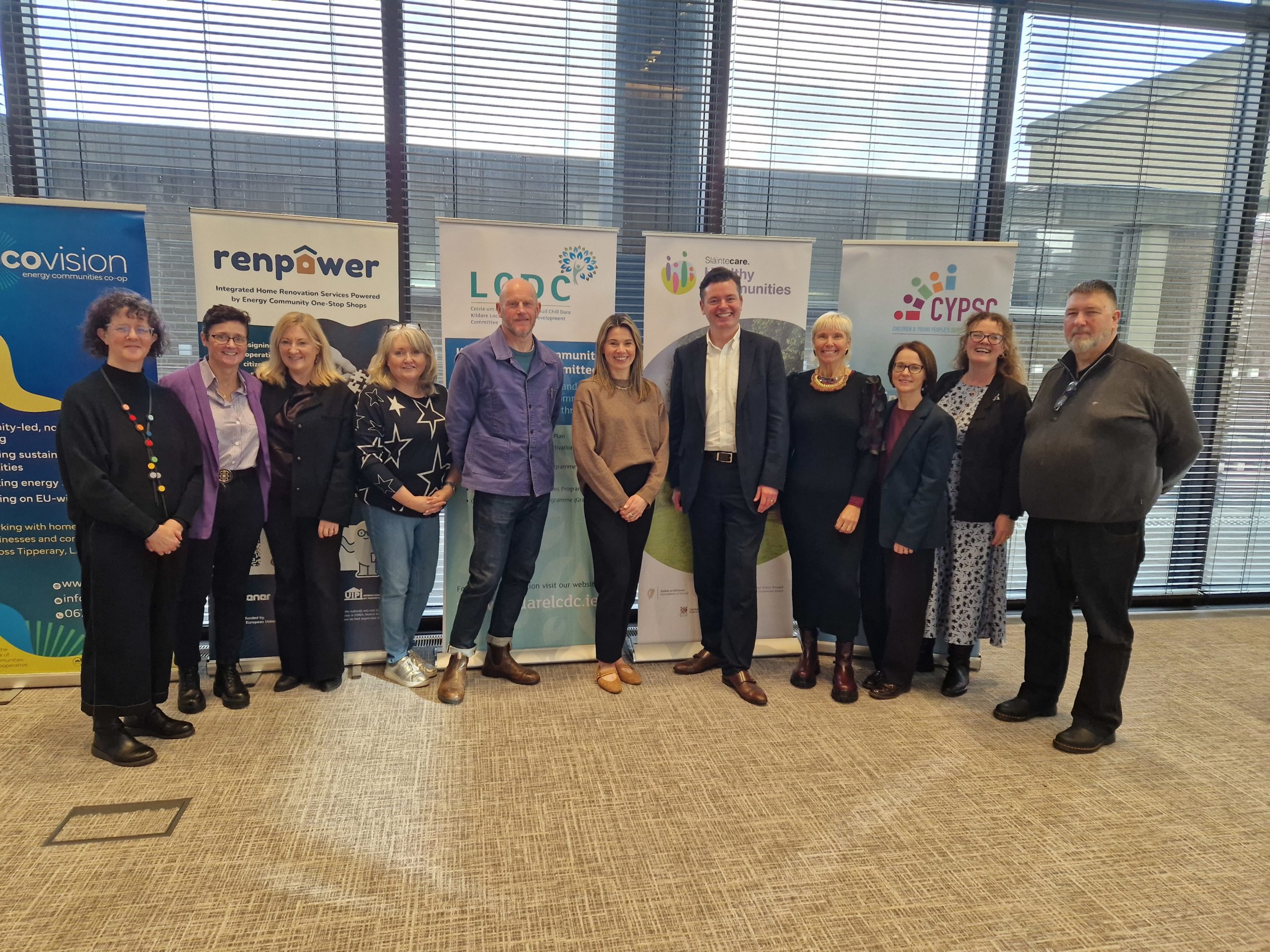
L-R: Margaret McQuillan, HSE Health & Wellbeing; Denise Croke, HSE Health & Wellbeing; Susan Bookle, Kildare LCDC; Brenda O’ Connor, Athy Community Family Resource Centre; Andy Bray, University of Limerick; Maria Healy, Kildare Sláintecare Healthy Communities; Simon Conry, Department of Children, Disability & Equality; Sarah Shakespeare, Teach Dara Community Family Resource Centre; Emma Berney, Kildare Children & Young People’s Services Committee; Ellen Duggan, Newbridge Family Resource Centre; and Tom Dunne, In Sync Youth & Family Services.
Next, the audience heard from Collette Deeney, the Monaghan CYPSC Coordinator, and Leona Keenan, Administrative Officer with Monaghan Local Community Development Company. Monaghan’s pilot, Interagency Action for Families (IAFF), aims to use a new ‘Family Champion’ role to coordinate services to help families experiencing intergenerational patterns of poverty, difficult household conditions, or challenges around their migrant status, and the “working poor” experiencing mortgage arrears. The audience heard about the in-depth interagency engagement work that took place throughout 2025. The Family Champion began work in May, and by the end of the year, nine families were actively engaged. Representatives from the pilot also presented on progress to the Joint Oireachtas Committee on Child Poverty and Deprivation in October 2025.
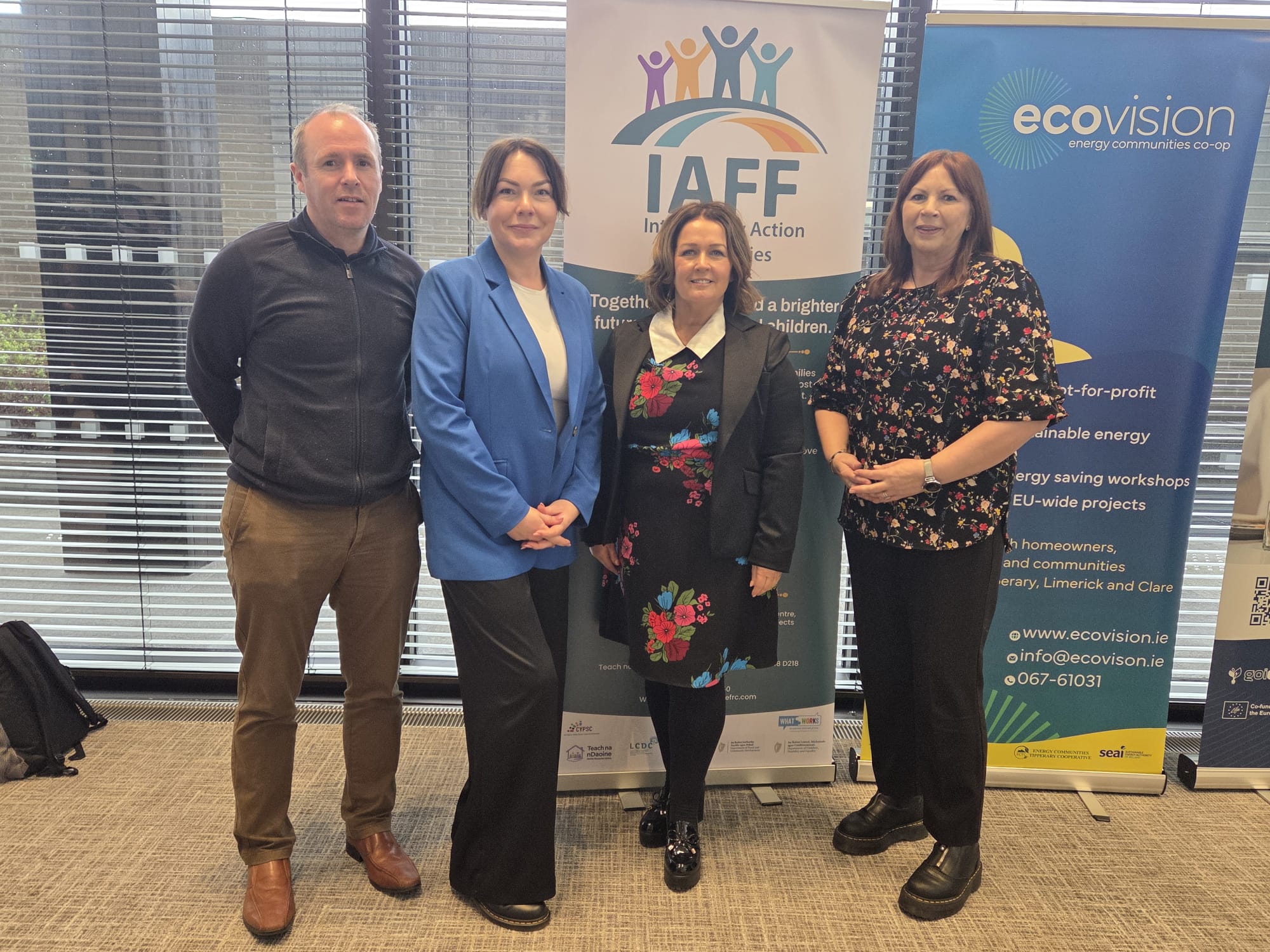
L-R: Gerard Callan, Monaghan Integrated Development CLG; Kamila Jancewicz, Teach na n Daoine FRC; Leona Keenan, Monaghan LCDC; and Collette Deeney, Monaghan CYPSC Coordinator.
In Tipperary, the pilot, ‘Engage in Energy,’ brings a focus to energy efficiency as a route to improving living conditions and reducing child poverty. The presentation began with input from Stephanie O’Callaghan, Tipperary CYPSC Coordinator, and Eoin Karr, the Tipperary County Council Healthy Ireland Coordinator. They presented on the context and rationale behind the pilot, and walked the audience through their planning phase. Next, two representatives from the primary project partner, EcoVision, presented in more detail on the supports and interventions provided: Máirtín Ó’Méalóid, the Managing Director, and Mona Zirngibl, the Projects and Development Coordinator. In 2025, 40 household energy audits had been completed in each of the three small areas covered by the pilot: Tipperary Town, Roscrea and Carrick-On-Suir. Early interventions, such as the provision of energy‑saving equipment, showed immediate benefits for many of the audited families. An interim report by researchers in the Technological University of the Shannon analysed data from the first 24 audited households, and found that the pilot successfully identified the energy inefficiencies and broader vulnerability factors requiring multi‑agency responses.
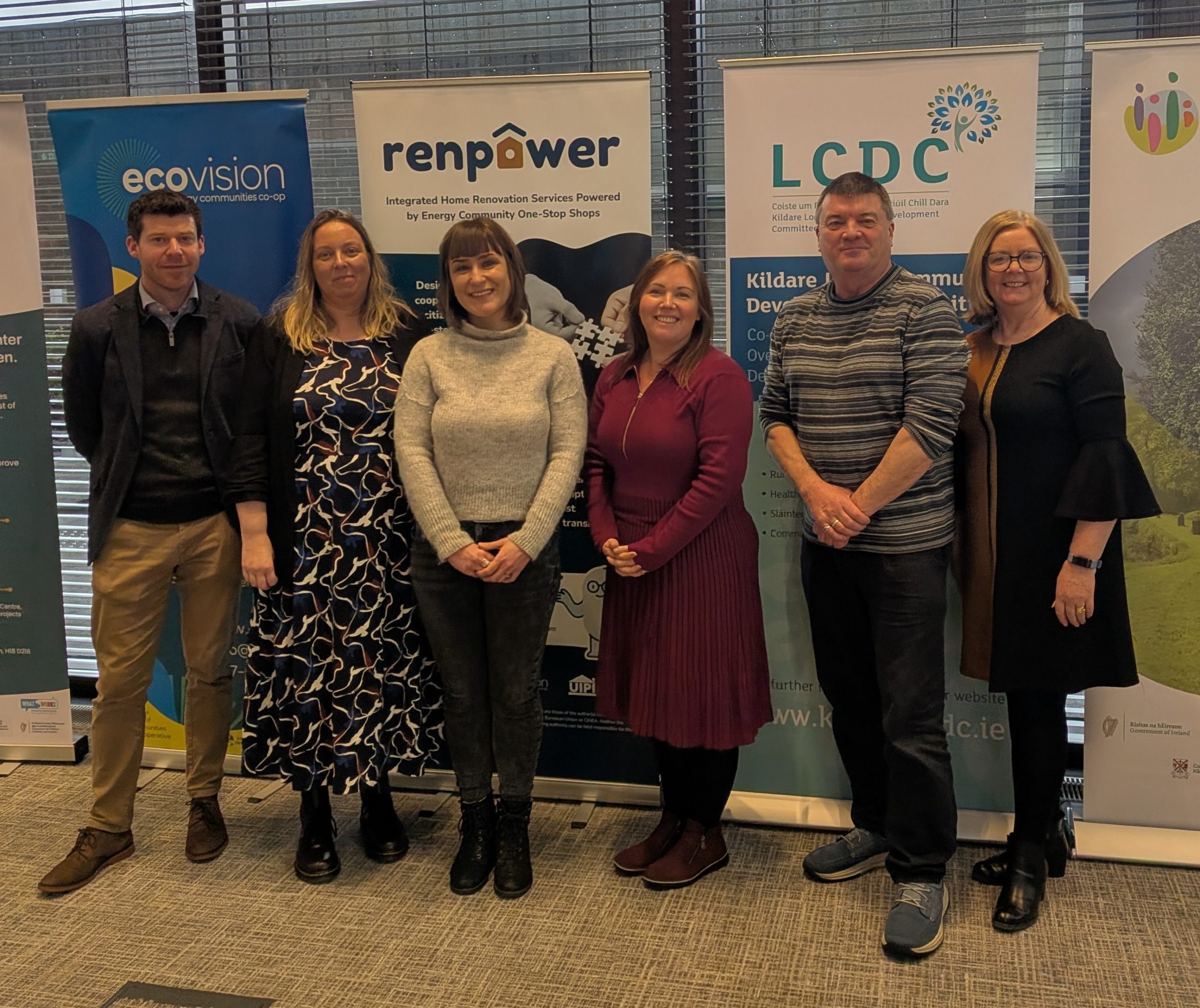
L-R: Eoin Karr, Tipperary County Council Healthy Ireland Coordinator; Stephanie O’Callaghan, Tipperary CYPSC Coordinator; Mona Zirngibl, Projects and Development Coordinator Ecovision; Máirtín Ó’Méalóid, Managing Director Ecovision; Maryrose O’Brien, SPECS Early Intervention & Family Support Manager, Bray & North Wicklow Area Partnership; and Fionnuala Curry, Wicklow CYPSC Coordinator.
Discussion and Q&A
The presentations were followed by a discussion and Q&A moderated by evaluators Andy Bray and Professor Laura Keyes from the Centre for Implementation Research at the University of Limerick. The evaluators began by asking the audience for insights or questions that responded to the proceedings so far. The audience feedback covered topics such as managing complexity while retaining human connection; overcoming difficulties during education transitions for children in poverty; building and maintaining effective and resilient relationships with other stakeholders in the local interagency landscape; and the challenges of working to an annual funding cycle.
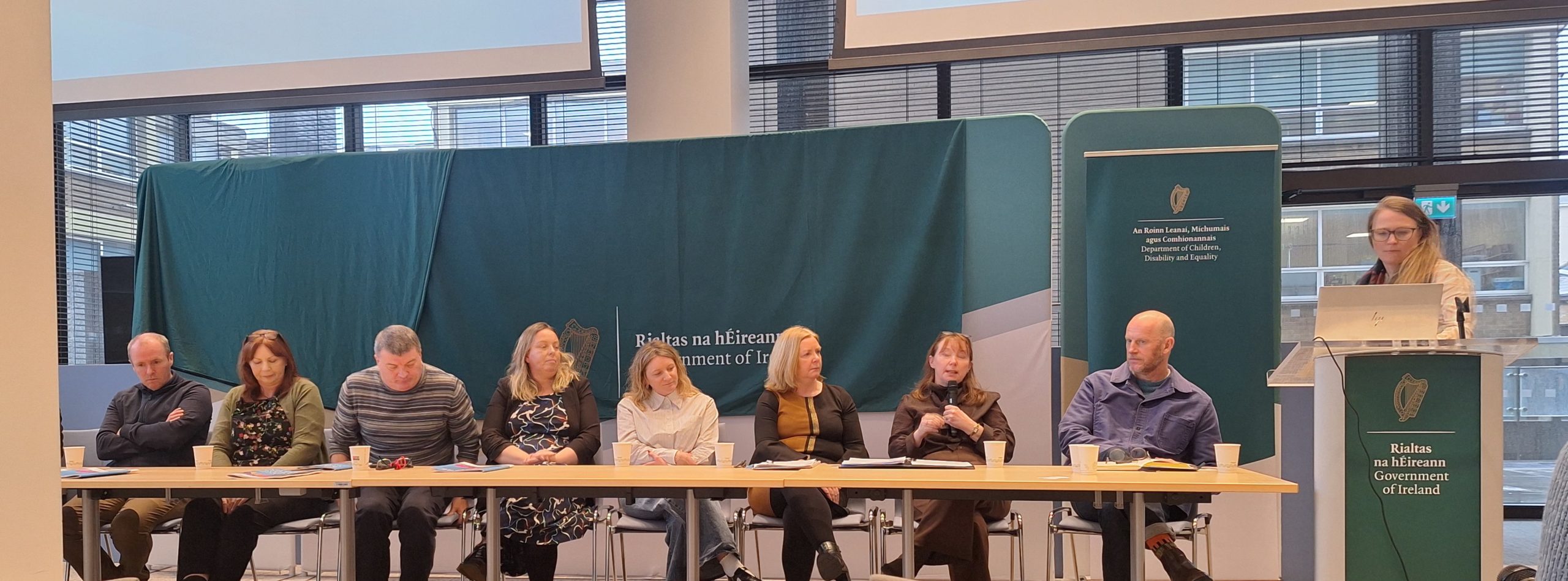
L-R: Gerard Callan, Monaghan Integrated Development CLG, Collette Deeney, Monaghan CYPSC Coordinator, Máirtín Ó’Méalóid, Managing Director Ecovision, Stephanie O’Callaghan Tipperary CYPSC Coordinator, Helena O’Brien, Dun Laoghaire-Rathdown CYPSC Coordinator, Fionnuala Curry, Wicklow CYPSC Coordinator, Adele O’Neill, Research and Community Networking Specialist, Bray & North Wicklow Area Partnership, Andy Bray, University of Limerick, Professor Laura Keyes, University of Limerick.
Conclusion
Simon Conry, Principal Officer of the Parenting Support Policy Unit, closed the event. In his speech, he acknowledged the time and effort that had clearly gone into the pilots throughout their first year. He noted some of the common challenges that have affected the pilots, such as recruitment difficulties across the health and social care sector, accessing good-quality data, and managing poverty stigma. He also mentioned some of the early successes of the pilots, underlining the value of agencies and partners coming together with a shared purpose to improve the lives of children, young people and their families experiencing poverty by better understanding their lived experience and supporting access to essential local services.
In his final remarks, he looked forward to year two, noting that the presentations and discussion demonstrated that “interagency coordination plays a vital role in ensuring that children and young people’s rights are realised.”